Swimming with Humpback Whales off Tahiti: the Four Months, the Six Swimmers and the Rules That Changed
Updated September 25, 2026 · 8 min read
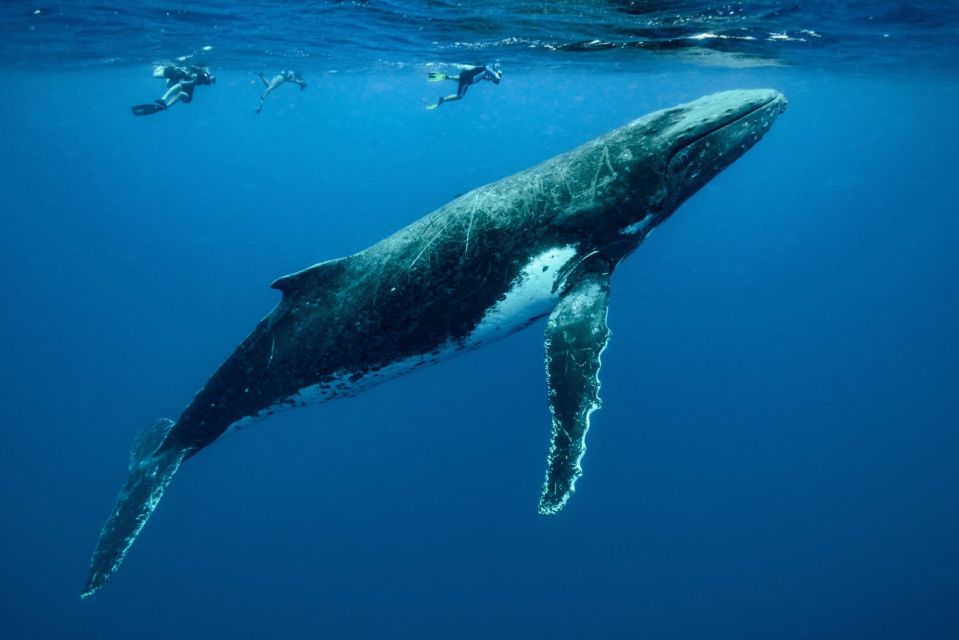
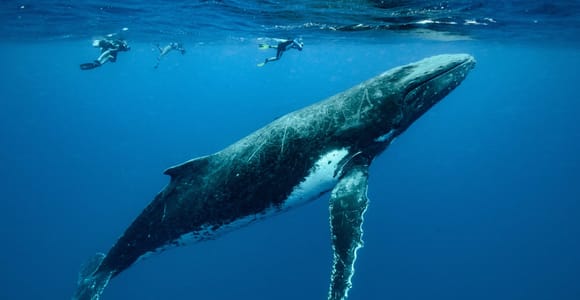
Humpback whales come up from the Antarctic to breed and calve in Polynesian water, and for four months a year you can get into the sea with them. At €250 for four hours it is one of the most expensive half-day products on this island, and it is the one where the difference between a good operator and a bad one is not comfort — it is whether the animals are left alone afterwards.
The rules were tightened at the end of 2024. Most of what is still written online describes the old ones.
The season is a legal date, not a probability
20 July to 20 November. That is not a guideline about when whales are likely to be around; it is the window in which observation is permitted at all, and outside it no licensed operator will take you.
You can see the date printed on the products themselves. One Tahiti whale-watching listing states, in its own first line, “From July 20th to November 20th (By Environmental Law)” — the operator putting the statute in the sales copy, which tells you how firmly it is enforced.
Observation is also limited to daylight working hours: 7.30 am to 5.30 pm, so the animals get the rest of the day undisturbed. An operator offering a sunset whale swim is offering something that does not exist.
What changed on 1 December 2024
The tightened regulation reorganised the whole activity. As reported when it took effect:
- Only licensed operators may approach. Free access for private boats is over. The number of licences was capped at 92 across the whole of French Polynesia.
- Private boats must stay 300 metres away. Licensed operators may not come closer than 100 metres under power.
- Three vessels maximum may be in the observation zone around one animal at any moment.
- Three knots maximum from the moment a boat enters the 300-metre zone, on a course parallel to the animal — no cutting across its track, no abrupt changes of heading or engine note.
- Six people in the water at once, and no more.
- Entering the water is banned in lagoons, bays and passes. Those are where whales rest, nurse and give birth, and they are exactly the sheltered places where swimming would be easiest.
- Approaching an unaccompanied calf is forbidden, and extra caution is required around a mother with a young one.
Observation is permitted off a defined list of islands, Tahiti and Moorea among them.
The binding text is the territorial decree, not a press summary, and the details get amended. The question to ask an operator is simply whether they hold a licence for the current season, and to see it. Ninety-two licences across an archipelago the size of Europe means a lot of boats do not have one.
What the €250 buys, and what it does not
The most reviewed version is the whale swimming boat trip from Moorea: €250, four hours, 4.6 stars from 148 reviews. From Tahiti, the five-hour whale watching and swim with humpbacks is €138 with 4.6 stars from 68 reviews.
There is also a version built explicitly around the six-swimmer limit — a group capped at six people with a hydrophone on board at €150. We mention it because the format is the right one and because honesty is cheaper than a surprise: it holds 3.8 stars from 17 reviews, the lowest of the whale products with at least ten reviews. A small group is not the same thing as a good morning.
None of them can promise you a whale. They are wild animals in open water; the boat looks, and sometimes the boat does not find one. Operators differ in what happens then, and that is a fair thing to ask before booking rather than after.
The medical and fitness list is longer than you think
The Moorea trip’s own “not suitable for” list runs to a dozen entries, and it is the most candid one we met on the booking pages of this inventory:
non-swimmers · low fitness level · people over 127 kg · people with back problems · people prone to seasickness · pre-existing medical conditions · recent surgery · people with epilepsy · wheelchair users · people with mobility impairments · people without experience
Read that as what it is: you are being put into open ocean, outside the reef, from a moving boat, and asked to swim clear of your own group. The swell there is not lagoon swell. If you have only ever snorkelled inside a reef, this is a different activity with the same equipment.
On anything medical the answer is your doctor or a pharmacy before you travel, not a travel page. What helps without anything at all is a morning departure and a night’s sleep.
The honest alternative
If the swim is not for you — and after the list above, for many people it will not be — watching from the boat is not a consolation prize. A humpback breaching at eighty metres is a better sight from the deck than from the water, where you are at sea level and see a fraction of it.
Whale watching from Tahiti is €193 over four to four and a half hours, 4 stars from 87 reviews, and it states plainly that entry into the water is a possibility rather than a promise.
Our whale listings hold 17 offers from €131.80, median €202.10, together carrying 469 reviews — the full set is on the whale watching page. It is the only genuinely seasonal category in our category set, which is why it sits near the front of the menu for four months of the year and nowhere for the other eight.
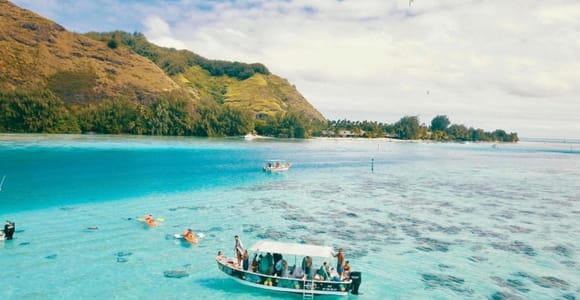
If you are here outside the season, the lagoon tours run year-round, and the rays and reef sharks of Moorea’s lagoon do not migrate.
Prices, ratings and review counts were read on 25 September 2026.