Around Tahiti Nui: 114 Kilometres, a Numbering System Instead of Addresses, and the Half of the Island the Road Never Reaches
Updated September 25, 2026 · 8 min read
Tahiti is two islands joined at a narrow waist: Tahiti Nui, the big round one with the capital on it, and Tahiti Iti, the smaller peninsula to the south-east. Only one of them has a road right the way around, and that distinction shapes every island tour sold here.
The ring road, and the counting
The road around Tahiti Nui runs 114 kilometres. It is not a motorway and it is rarely empty, and the realistic driving time without stops is well over two hours.
What surprises most first-time visitors is how places on it are described. There are hardly any street addresses outside central Papeete. Instead there is the PK — point kilométrique — a concrete marker at every kilometre, counting outward from PK 0 at Papeete cathedral.
The numbers run in both directions from there, up the east coast and down the west, and the two counts meet at the Taravao isthmus where the two islands join. It is a line, not a loop: the numbers do not run continuously round the island and then back to zero.
A full local address reads like this: PK 10,5, côté mer, côte ouest – Punaauia. Kilometre marker, which side of the road, which coast, which commune. Côté mer is the sea side, côté montagne the mountain side. Once you know the pattern, a phone number and a PK are enough to find anything on this island.
What the half-day circle actually visits
The most reviewed coast-road circuit in our listings is the half-day small-group circle tour with waterfalls and caves: €101.05, 4.7 stars from 159 reviews, four and a half hours in an air-conditioned van.
Its published stops are the ones that matter on this coast:
- Mara’a grottoes — fern-hung caves right beside the west coast road
- Vaipahi water gardens — a planted valley with pools, on the south-west
- Faarumai waterfalls — inland from the east coast near Tiarei
- Point Venus and Matavai Bay — the black-sand cape north of Papeete
- a marae at Ta’ata in Paea — an open-air stone temple platform
Included: the van, the guide, a bottle of water, a headset so you can hear the commentary, and hotel pick-up and drop-off. That last one is not a small thing on an island where the alternative is finding a parking space at every stop.
The stops are free; the guide is what you are buying
This is the part that no operator will put on a booking page, and it should change how you decide.
Point Venus and the Faarumai waterfalls cost nothing to visit. The waterfalls need no ticket at all. Mara’a’s grottoes are at the roadside. If you have a car and a full day, you can do this circuit yourself for the price of fuel.
What you would be doing without is the commentary — and on this island that is more than filler. Point Venus is where Cook’s expedition observed the transit of Venus in 1769, which is why the bay has the name it has and the cape has a lighthouse on it. A marae is not a ruin; it is a temple platform with a function. Nothing at any of these sites explains itself.
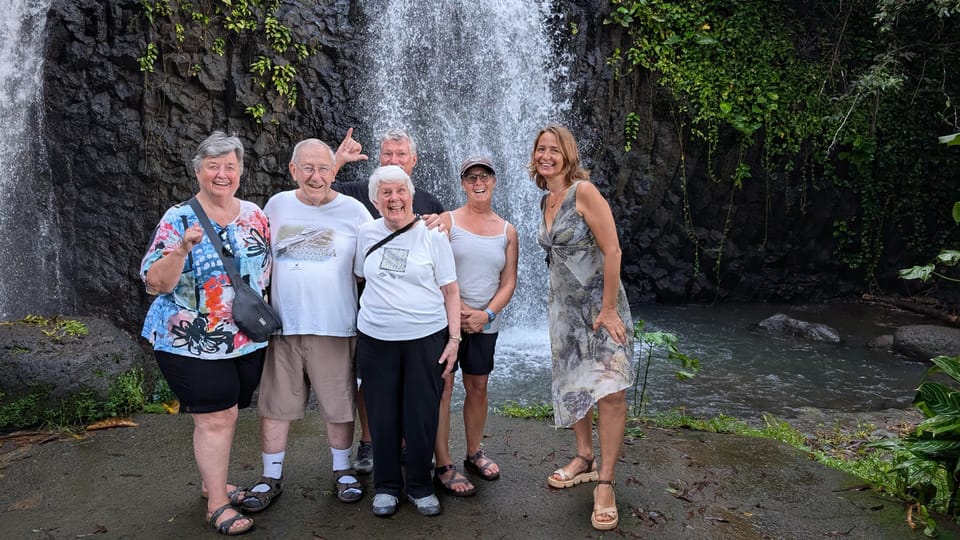
Faarumai is worth knowing in detail because tours differ in how far they go. There are three waterfalls: Vaimahuta at 80 metres, a few minutes from the car park, and then Haamaremare Rahi at 100 metres and Haamaremare Iti at 40 metres, twenty to thirty minutes further on foot. No booking page says which of the three a tour stops at — and that walk, there and back, does not fit inside four and a half hours. Ask, if a particular one matters to you; the far two need a morning of their own.
Who it does not suit — and the minimum-four rule
The operator names three exclusions: people over 130 kg, people with back problems, and people with mobility impairments. Given that the day is mostly sitting in a van with short walks at each stop, that third one is worth asking about directly rather than assuming.
There is a second condition that catches people, and it has nothing to do with fitness: this tour requires a minimum of four guests, with final confirmation sent 24 hours beforehand. A couple booking for a fixed date can be cancelled the day before through no fault of their own. If your day on Tahiti is not movable — a cruise call, a flight the next morning — that is a real risk, and it argues for booking a tour without a minimum or for an earlier date with a fallback.
Cruise passengers are picked up at the cruise terminal, where the guide holds a sign with your name on it. Shared tours run in English by default.
The half the road never reaches
Tahiti Iti, the peninsula, has no ring road and is not going to get one. The road along its north side ends at the village of Tautira. The road along its south side ends at Teahupo’o, the surf break. Between those two points lie about 30 kilometres of coast with no road at all — the Te Pari cliffs, reachable on foot or by boat with a guide, and by nothing else.
So “circle island tour” on Tahiti means the circle of Tahiti Nui. The peninsula is a separate trip, and the tours that include Teahupo’o say so and take a full day: the west coast combo tour to Teahupo’o runs eight hours at €220, 4.8 stars from 54 reviews.
What else is in this category
Our circle island tours listings hold 23 offers from €40.14, with a median of €220 and 684 reviews between them. The spread is wide because the category contains both half-day van circuits and full-day private cars: the west and east coast tour with waterfalls takes five hours at €86 with 4.8 stars from 32 reviews, while a private guide for the day runs into the hundreds.
If the coast road is not enough and you want the middle of the island, that is a different vehicle and a different day — the Papenoo valley by 4WD. For the city at PK 0 itself, see Papeete’s market and roulottes.
Road distances, the PK system and the waterfall heights are as published by local and territorial sources; prices, ratings and review counts were read on 25 September 2026. Sites in a wet, steep landscape close for repairs from time to time, and the tour that visited a waterfall last month may divert past it this month.